About
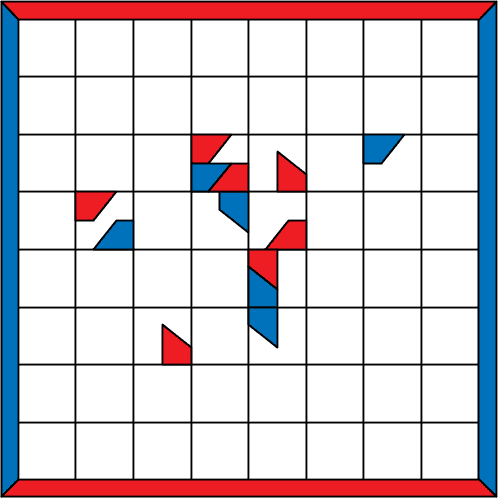
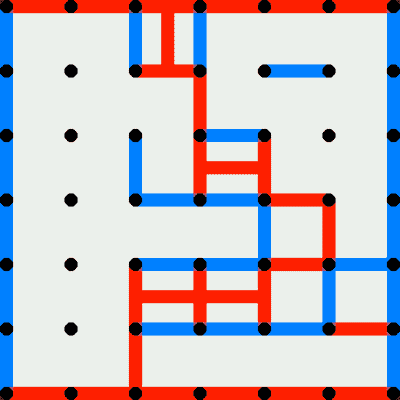
IntroductionTrisq is a drawless connection game for two players: Red and Blue. It's played with trapezium-shaped pieces on an initially empty square board. The top and bottom edges of the board are colored red; the left and right edges are colored blue. The recommended board sizes are between 6x6 and 9x9.
All pieces are the same and only differ in color. They can be placed in any orientation, but always with the front side up. Thus, when playing on a physical board, the back side of the pieces should be marked so as to distinguish it from the front side. A square can accommodate four pieces, and no piece can be placed in a way that makes this physically impossible.
DefinitionsTwo pieces are point adjacent if they share nothing more than a vertex, and edge adjacent if they share at least part of a side longer than a vertex.
PlayRed plays first, then turns alternate. On his turn, a player must place one or two pieces of his color on empty spaces of the board. On his first turn, Red can only place one stone.
At the end of a turn, for any two point adjacent, like-colored pieces there must be at least one like-colored piece edge adjacent to both.
Passing is not allowed. Players will always have a move available and must make one.
The game is won by the player who completes a chain of edge adjacent pieces of his color touching the two opposite board edges of his color. Draws are not possible.
AcknowledgementsThe featured placement restriction was first used in Corey Clark's Slither. Asymmetric, variable orientation cell division was first used in Mark Steere's Tripen.
2
Players
60 min
Play Time
2.0
Medium
5+
Age
Mechanics
Categories
More by Luis Bolaños Mures


Similar Games




Reviews
💬
No reviews yet
Be the first to share your thoughts