Search
1977
BGG Average Rating
2.5
community average
Players
2-4
Weight
N/A
⚙️ Game Mechanics
How this game works - core systems and player actions
📂 Categories
🏢 Publishers
📖 About This Game
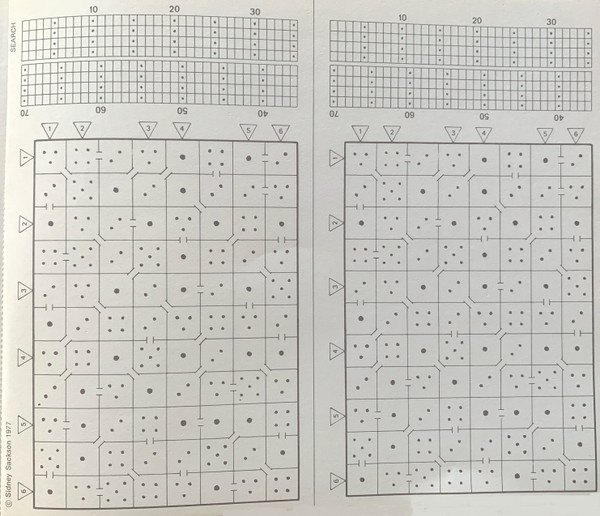
Search is a cooperative paper-and-pencil game that appeared in Sackson’s book Beyond Competition. The playing field is an 8x11 grid of squares representing an haunted house. Each square has from 1 to 3 dots in it. Each room is connected to one other room by a corridor. Six of the rows and six of the columns are marked by triangles with the numbers 1-. Each players uses different colored pencil. Players determine their starting room by drawing two cards from a deck of 24 cards #d 1-6 (4 of each value) then circling the dots in one of the rooms where the row and columns indicated by the triangles correspond to the cards drawn. A player may never enter a room occupied by another player or connected to such a room by a corridor (if a player would start in such a room, they draw again).
On subsequent turns, each player must move as follows. 1) if they are in a room and they have already visited the connecting room, they my move to any adjacent room (obeying the rule above) and circle the dots in that room. Except that they may move to room that has the same number of dots that are in ANY player’s (including their own) current room. If they are unable to move to a room, they lose their turn and continue to lose their turn until they can move to another room or until the game ends.
2) if they are in a room and they have not visited the connecting room, they must circle the dots in the connecting room, regardless of the number of dots in that room. Each time player moves to new room (by either method), they color in the circle of room they left, so that the room with the circled dots always represents their current position. They also check off a number of boxes on their score track equal to the number of dots they circled. Players must move if they are able to.
The game ends when no player is able to move. The players’ is equal to the number of the highest checked box of the player who has advanced the farthest on their track minus five times the difference between that player’s position and the position of the player who has advanced the fewest spaces. If that score is positive, the player’s win; else they lose.