Kalah
BGG Geek Rating
2.9
BGG Average Rating
3.0
community average
BGG Ranking
#4277
all board games
Platform Ratings
Rate the digital implementation
No ratings yet
No ratings yet
No ratings yet
No ratings yet
No ratings yet
No ratings yet
Players
2-2
Weight
1.6
Playtime
10 min
Age
5+
🎮
Play Online
Available on multiple platforms
📂 Categories
🎨 Artists
🏢 Publishers
Parker Brothers
Lagoon Games
Piet Hein & Skjøde
Gemini Games
Piet Hein A/S
The Canadian Group
Barnes & Noble
Oficina do Aprendiz
Ludens Spirit
Carrom Art
Philos
Whitman Golden Ltd.
Great American Trading Company
Goki
Joen
Worldwide Games
Pelikan
DeAgostini
Melissa & Doug
Brookstone
Games & Graphics Inc.
Gener8 LLC
Adrenaline Brush Ltd
Holzinsel
Planet Finska
Toy Place
Dilemma Games
PICO PAO / Juegos de la Antigüedad
Müller Ltd. & Co. KG
Cylinder Games
Bohemia
Domino-Verlag
Gerd Koch
Daddy-O Productions
Juguetes del Puerto
Dal Negro
Kontrell Industries
Learningsmith
Maplegrove
Lazy Days (I)
Pavilion
Plastolus Szarvas
Profound
Woodstock Spiele
SPM: Syarikat Permainan Malaysia
Top-Toy
Top-Game
Gemini-Games
WWF
Wood Expressions
Square Root Games
Geoludie
IKEA
VEB Plastspielwaren Berlin
Skor-Mor
Origem
ABRA
ASS Altenburger Spielkarten
Brio AB
Jumbo
danspil
L. P. Septímio
Pin International
E. S. Lowe Company Inc.
Creative Crafthouse
Pressman Toy Corp.
Fundex
Schylling
Fratelli Fabbri Editori (Fabbri Editore)
Mitra
Endless Games (I)
Spin Master Ltd.
CHH Games
Plasticart
Alga
Target
Schmidt Spiele
Yellow Mountain Imports
Classic Games
Monkey Pod Games
Estrela
Hartung-Spiele
Dujardin
Noris Spiele
RCR Terry GmbH
Fame Products
Intermón Oxfam
Moderne Spieltechnik Gatzweiler G.m.b.H.
Science4You
Natural Wonders
Speedgame
Starbucks Coffee Company
Spear's Games
Cardinal
Joker
(Public Domain)
Ramsons
King International
University Games
Elven Games
Brain Games Germany
(Unknown)
Tactic
Queen Games
📖 About This Game
The most common rule set in games sold commercially as Mancala is for this game of Kalah. Mancala is actually a whole family of games. Kalah was invented in 1940 by an American, William Champion Jr.. He started selling the game in 1944, patented the rules in the 1950's, and founded the Kalah Game Co. in 1958.
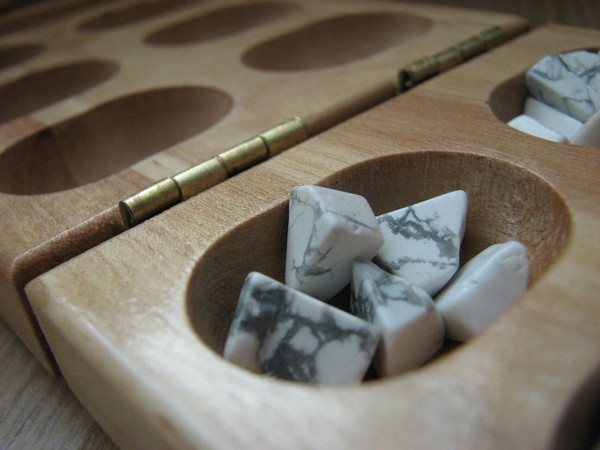
The game is played on a board of two rows, each consisting of six round pits. The rows have a large store at either end called the Kalah. A player owns the six pits closest to them and the Kalah on their right side.
The game is started with four (4) seeds in each pit. A player takes all the seeds from one of their pits, and then they are distributed one by one, counterclockwise, in the pits and the player's own Kalah, but not into the opponent's store (Kalah). If the last seed is dropped into an opponent's pit or a non-empty pit of the player, the move ends without anything being captured. If the last seed falls into the player's Kalah, they must move again. If the last seed is put into an empty pit owned by the player, they capture all contents of the opposite pit together with the capturing piece and puts them in their Kalah. If the opposite pit is empty, nothing is captured. A capture ends the move.
The game ends when one player no longer has any seeds in any of their holes. The remaining pieces are captured by their adversary. The player who has captured the most pieces is declared the winner.
Variants:
Beginners may start with 3 seeds in each pit, but the game can also be played with 5 or 6 seeds in each pit. William Champion Jr. recommended the expert game with 6 in each pit.
In the Philippines Version (called Sungka locally) the game is often played with small shells, there are 7 pits on each side as well as the Home and the game is started with 7 shells in each pit.