About
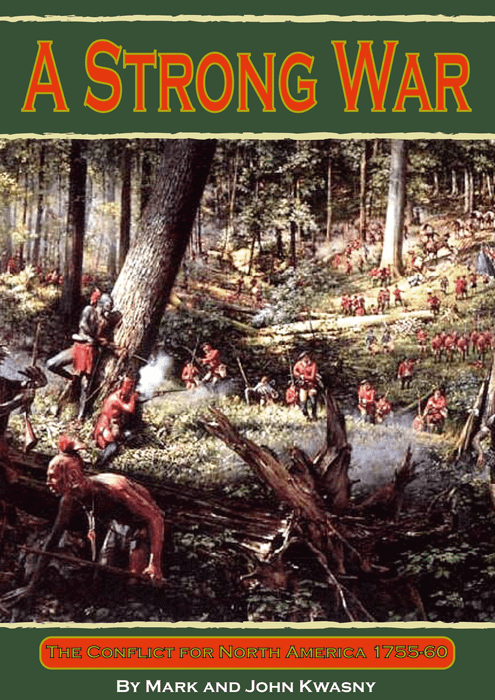
The title, A Strong War, refers to the type of war the Abenaki Nation threatened to unleash on the land-grabbing British in 1753. The sparks of war, ignited in 1754 near Fort Duquesne by an obscure colonel of Virginia militia, George Washington, spread quickly; soon, flames engulfed the entire globe as England and France vied for control of empire. Over the next 5 years, Regular regiments from the French and British armies, American and French-Canadian provincial units, and Native warriors all fought in a chaotic and violent series of campaigns and frontier raids that culminated in the British conquest of French Canada and the defeat of the Native Nations (most of which had sided with the French).
A Strong War brings this war to life in a simple, fast-playing game. The map (covering the region stretching from Louisbourg to Alexandria, and from New York to Lake Erie) uses point-to-point connections to highlight the key locations that were targeted during the war. Using wooden cubes to represent the different types of forces used (French and British Regulars, British Colonials, French-Canadian Marines, French Bush Rangers, and Native American warriors), each player has only a few pieces (maximum 13 for the British and 10 for the French) to use each turn (one turn = one year, so there are 6 turns/years total).
The heart of the game is the unique combat system where players can deploy forces to a chosen battle and then commit them one by one; or they can call off the battle if it goes badly and save some of those forces for use later in the year. The types of forces committed also play a critical role in combat – the British want to mass their Regulars but the French want to bring in a mixed force to take advantage of the different skill sets each provides. Thus, tension is created in trying to decide if/when (or where) it is best to commit one’s forces: do you avoid combat completely; do you call off a combat that is going badly; or, do you go all in and commit your entire force? But if you lose a battle, initiative then swings to your opponent who may then launch an offensive.
Each player has several paths to victory, leading to a “different” game each time, and forcing players to choose between different strategies each turn. Finally, it is a quick game, taking just a couple of minutes to set up, and usually taking less than an hour to play to completion. The game also plays well solitaire, though there is no dedicated solitaire system.
—description from the publisher
1-2
Players
120 min
Play Time
N/A
Complexity
14+
Age
Mechanics
Categories
Similar Games


Reviews
💬
No reviews yet
Be the first to share your thoughts