Purple Heart Valley
1992
Not Rated
No ratings yet
Players
2-4
Weight
N/A
Playtime
240 min
⚙️ Game Mechanics
How this game works - core systems and player actions
📂 Categories
🏢 Publishers
📖 About This Game
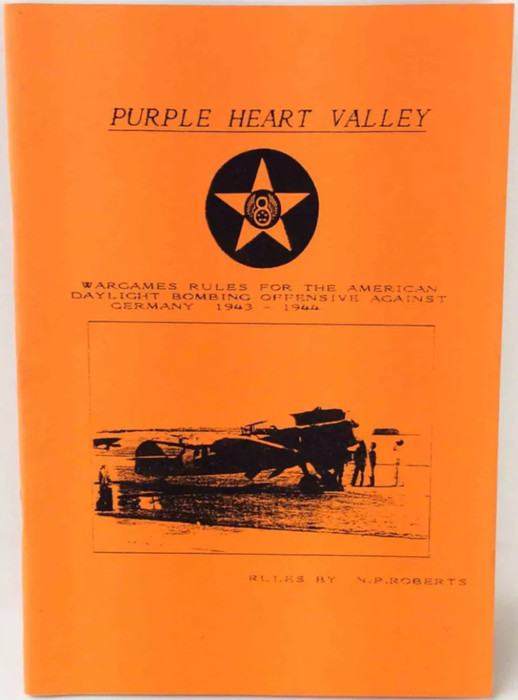
Wargame rules for the American daylight bombing offensive against Germany 1943-1944. Flights of B-17 bombers press through enemy defenses on their way to the target, protected only by limited fighter escort and their own "combat box" defensive formations. Multiple combat boxes would fly in support of each other, with the lowest and last in line being the most vulnerable, sometime earning the nickname "Purple Heart Valley".
Games are played in turns where both attacking and defending fighter aircraft pre-plot a maneuver for the turn from lists tailored to the attitude the aircraft ended its last maneuver in; either climbing, diving, or level. Maneuvers are then resolved simultaneously across two phases where aircraft may move and/or change altitude in either or both phases depending on the chosen maneuver. At the end of each phase is an opportunity to engage enemy aircraft that are within range and arc of fire of your weapons. An example of a maneuver is D1 (or Dive 1). This maneuver is executed by decreasing one altitude level in the first phase (which might bring the aircraft into or out of range of an opponent for the following attack opportunity), followed by a move of one hex directly forward in the second phase (again perhaps altering the possibility of attacks in the second attack opportunity). There is also a 1D maneuver, which is the reverse; move in the first phase and dive in the second. B-17's themselves do not move except for a very limited set of allowed maneuvers to try and rejoin formation should they fall out because of damage sustained. The majority of the actions taken by B-17's is firing their bristling gun positions at incoming enemy fighters!
Weapon attacks by all aircraft are resolved by rolling a D6 on a table with to-hit target numbers that depend on the type of aircraft being targeted (fighter or bomber), the range to it in hexes or altitude levels (max 3 in both cases), and the general orientation of the attack (head-on, astern, or all others). A very small number of parameters might modify this dice roll either up or down and fighters can choose the length of burst they are firing from their limited store of ammunition. Successful hits require the target to roll percentile dice on damage tables that are specific to either fighters or bombers, and to the orientation of the attack. Damage to the hit aircraft is marked on an aircraft record sheet, but only what the attacker could "see" is reported to them, providing a nice little bit of fog of war. For example, a fighter attacking a bomber would not know if a particular crew member was killed in the attack, but would see if bits of the bomber were blown off, an engine started to smoke, or no apparent effect was caused.
Games can be played as one-off engagements between bombers, escorts, and attackers, or as a campaign which simulates an entire bombing mission from take-off to target. This is done by taking off in England and then flying through up to 5 abstract zones (depending on the length of game being played) that start at the French coast, cross Western Europe, and end over Berlin. Each zone going deeper into enemy territory is limited in the type of escort fighters that can accompany the bombers. When playing missions in 1943 the last zones might be unescorted since long range Mustangs have not yet entered service. The Luftwaffe player(s) assigns their available fighters before the campaign is begun to any of the zones in play. Starting with Zone 1, when the bombers (and any escorts) reach the zone an engagement is played out if it is defended by enemy fighters. If it is not, a light flak attack is resolved against the bombers and then they are moved to the next zone. Upon reaching the final zone, which is the bombing target, either an engagement is played out if it is defended, or a light flak attack if it is not, and then another flak attack is resolved at a randomly determined intensity depending on the depth of the zone. The deeper the zone, the more likely the flak will be heavy! Then any surviving bombers make an abstract bombing attack which will add a random number of victory points to the USAAF total. Additional victory points are scored for each surviving bomber, scaled to how deep a zone the raid was conducted in; the deeper the zone, the more victory points earned. The Luftwaffe player(s) scores victory points for each enemy bomber and escort fighter destroyed, minus points for each friendly pilot lost.