Morphos
2016
BGG Average Rating
4.2
community average
Platform Ratings
Rate the digital implementation
No ratings yet
Players
2-2
Weight
N/A
Playtime
60 min
Age
5+
⚙️ Game Mechanics
How this game works - core systems and player actions
📂 Categories
🏢 Publishers
📖 About This Game
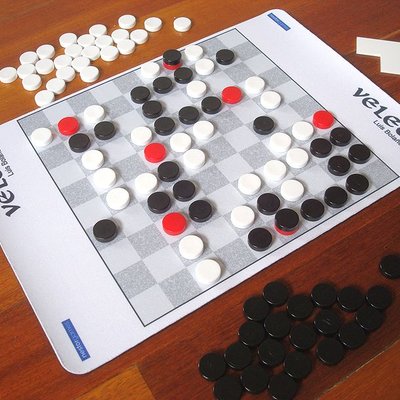
Morphos is a connection game for two players: Black and White. It is played on the intersections (points) of an initially empty square grid (board). The top and bottom edges of the board are colored black; the left and right edges are colored white.
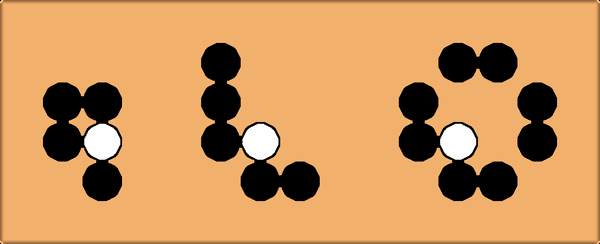
Black plays first, then turns alternate. On your turn, place a stone of your color on an empty point or replace (flip) a weak enemy stone with a stone of your color. A black stone is weak if it is part of at least one of the following patterns or their translations, rotations or reflections:
Black stone on b2 and white stones on b3, a3, a2 and b1.
Black stone on b2 and white stones on a4, a3, a2, b1 and c1.
Black stone in a 2×2 area orthogonally adjacent to eight white stones.
Likewise, with colors reversed, for weak white stones.
Passing is not allowed, but, if you have no legal moves available, your turn is skipped.
You win if there is a chain of orthogonally connected stones of your color touching the two opposite board edges of your color. If neither player has a move available and neither player has won, Black wins if there is at least one pair of vertically adjacent, like-colored stones, and White wins otherwise.
To make the game fair, White will have the option, on their first turn only, to swap sides with Black instead of making a regular move.
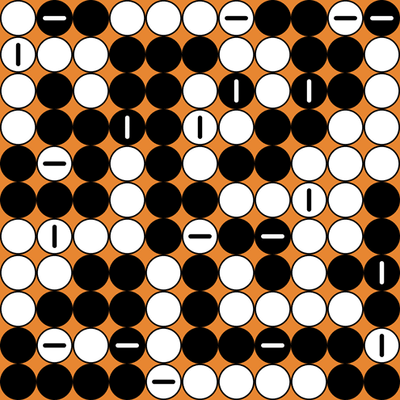
NotesOn an n×n board, the number of deadlocks, including symmetrical copies, is 2^(n + 1) - 2, i.e. two less than four times the number of compositions of n. Note that, in a deadlock, there can be vertically adjacent, like-colored stones or horizontally adjacent, like-colored stones, but not both. If there are no adjacencies of either type because the stones form a checkered pattern, White wins.
The following mutators can be applied to alter the character of the game:
Minimorph: The last weakness pattern is not used, and the other two have the stone in the top left corner removed from them. This requires a larger board than the standard game, as it makes blocking quite harder. On the other hand, deadlocks are impossible. All other mutators on this list work best when combined with this one.
Deepmorph: A stone that was flipped by your opponent on their latest turn still counts as a friendly stone for flipping purposes. In this case, the winning condition must be checked for a player at the start of their turn, and it is illegal to flip a stone if the opponent could flip it back on their next turn.
Duomorph: After placing (not flipping) a stone on your turn, you must, if possible, place a second friendly stone on an empty point orthogonally adjacent to the first one.
Remorph: When you remove an enemy stone and there are empty points on the board, place the removed stone next to the board. On their next turn, your opponent must place the stone back on an empty point of the board and then make a regular move.
Metamorph: The game starts with the board filled with stones in a checkered pattern.