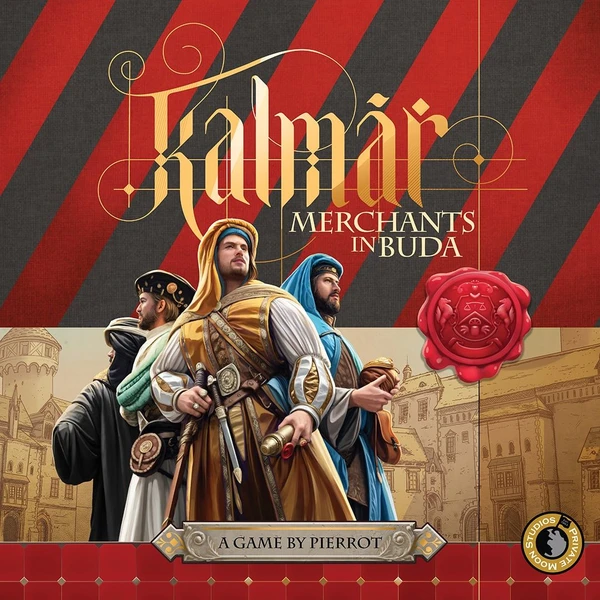
Kalmár: Merchants in Buda
2025
BGG Average Rating
9.0
community average
Login to vote on your own rating
Players
2-4
Weight
N/A
Playtime
150 min
Age
14+
⚙️ Game Mechanics
How this game works - core systems and player actions
🎨 Artists
🏢 Publishers
📖 About This Game
In the early 15th century, a wealthy merchant of Buda, now in the autumn of his years, decides to hand over the leadership of his prosperous trading empire to the child most fit for the task. To determine the successor, he announces an unusual challenge: each heir will have one full week to prove their worth. The rival merchant brothers aim to maximise their wealth and prestige through the optimal utilisation of available opportunities. To succeed, they must not only deliver on their promises, but also donate generously and host banquets to forge valuable contacts. At the end of the week, the heir with the most prestige points will be the winner.
The game spans 7 rounds – one for each day of the week. Players have 7 action points to spend every day, and they start the game with a modest 7-thaler capital. Each day is divided into morning, daytime, and evening phases. The most important actions are in the daytime phase. In the morning and evening phases, automatic events take place – like ‘games within the game’ – which can significantly influence trading success.
Players should make the most of every opportunity and plan ahead to build a fortune large enough for both investments and donations, while constantly deciding whether to take money or prestige points in exchange for their goods. Action points can be spent freely, but every turn begins with movement on the board – and each step costs an action point. At the destination – whether it is a townhouse, an institution, a craftsman’s workshop, or the bustling city gate – players may perform all available actions or what they are able to. Some actions are location-specific, while others can be carried out anywhere and at any time.
Within the city, the supply of goods is limited. However, the merchants can also rely on various other sources, such as the market (open three times a week), the ships docking at the harbour, a central storehouse, and even the black market – where goods from rural estates can also be found. Goods form production chains, which can be cleverly exploited during the game. But merchants must watch their warehouse stock: any items not delivered within three days are lost, at a heavy cost. On the other hand, a quick turnover of stock is rewarded with prestige points via an agility gauge. Additional points can be earned through two types of objective cards, as well as from partner cards gained at banquets, which grant one-time or permanent abilities.
Kalmár also offers a special two-player mode, featuring a new character that allows each player to control two merchant figures. A shorter version of the game is also included, covering only the last four days of the week – from Thursday to Sunday.
—description from the publisher
A 15. század elején egy gazdag budai kereskedÅ‘ versenyt ír ki a gyermekeinek: arra bízza a kereskedÅ‘birodalom irányítását, aki egy teljes hét leforgása alatt bebizonyítja a rátermettségét. A rivalizáló testvérek célja, hogy a hét során felmerülÅ‘ kereskedelmi lehetÅ‘ségek optimális felhasználása révén minél nagyobb vagyont, tekintélyt és népszerűséget szerezzenek. Ezért fontos, hogy ígéreteiket idÅ‘ben teljesítsék, bÅ‘kezűen adományozzanak, illetve bankettek rendezésével igyekezzenek hasznos támogatókkal bÅ‘víteni kapcsolataikat. A versengést az nyeri, aki a legtöbb presztízspontot gyűjti a hét során.
A játék 7 fordulóból – azaz 7 napból – áll. A játékosok minden nap 7 akcióponttal gazdálkodhatnak, és mindössze 7 garas induló tÅ‘ke áll rendelkezésükre. A napok reggeli, nappali és esti szakaszból állnak. A nappali szakaszban zajlanak a legfontosabb akciók. A reggeli és az esti szakasz eseményei egyfajta „játékok a játékban”, amelyek mindenki részvételével, automatikusan bekövetkeznek, és befolyásolhatják a kereskedelmi tevékenység eredményét.
EzekbÅ‘l a lehetÅ‘ségekbÅ‘l kell a játékosoknak elÅ‘relátó tervezéssel olyan vagyonra szert tenniük, amelybÅ‘l befektetésekre, adományozásra is jut – ugyanis folyamatosan dönteniük kell: pénzt vagy népszerűséget - presztízspontot - válasszanak az eladott áruért cserébe. Mindenki szabadon oszthatja be az akciópontjait, de a kört mindig lépéssel kell kezdeni a táblán – és minden lépés akciópontba kerül. Az érkezés helyszínén, amely lehet egy városi polgárház, egy intézmény, egy mester műhelye vagy a forgalmas városkapu, minden akciót végrehajthatnak a játékosok, amire csak lehetÅ‘ségük nyílik. Egyes akciók csak bizonyos helyszíneken, míg más akciók bárhol, illetve bármikor végrehajthatók.
A város területén szűk a kínálat. Szerencsére más forrásokra is támaszkodhatnak, mint például a heti háromszori piac, a kikötÅ‘be befutó hajók, egy központi raktár – vagy akár a feketepiac, ahol a városon kívüli birtokokon termelt áruk is elérhetÅ‘k. A különféle áruk termékláncokat alkotnak, ami a játék folyamán ügyesen kihasználható. Azonban oda kell figyelni a raktárban tárolt tételek lejáratára: komoly veszteségekkel jár, ha egy eladás vagy megrendelés három napon belül nem teljesül. Ugyanakkor a készletek gyors forgatását presztízsponttal jutalmazza egy erre szolgáló agilitásmérÅ‘ eszköz. További pontszerzési lehetÅ‘séget ad kétféle célkártya, valamint a banketteken szerzett, egyszeri vagy állandó képességeket is nyújtó partnerkártyák.
A Kalmár külön játékmódot tartalmaz két fÅ‘ számára, melynek különlegessége, hogy egy új karakter is megjelenik, ezáltal a játékosok 2-2 figurát irányítanak. Ezen kívül a játék rövidített verzióban is játszható, ami nem a teljes hetet, hanem csak a csütörtöktÅ‘l vasárnapig terjedÅ‘ idÅ‘szakot öleli fel.
—description from the publisher (translated)