
About
An abstract, cooperative game for 2 or more players on an hexagonal board.
Overview:
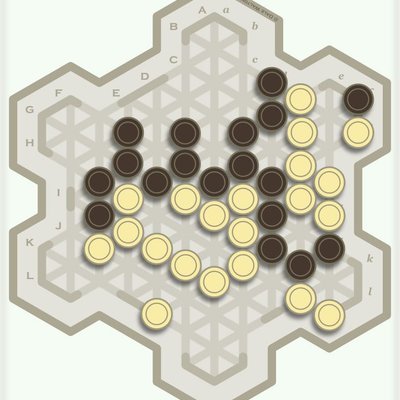
The board starts with 3 colors of tiles spaced evenly across all the spaces of the board such that each tile is isolated from the tiles of its own color. The goal is to join all the isolated tiles to form communities of their own color so that no tile is left isolated. This is accomplished by players swapping nearby tiles while moving their pawns.
The goal must be achieved without talking or indicating to another player what you intend to do, nor what you wish them to do on their turn. The nature of the game is to correctly judge the skill, motives and actions of your collaborators so that the group reaches the goal as quickly as possible, and does not get stuck.
Play
Each player starts the game with one piece, placed one tile in, from opposite corners of the board.
A turn consists of swapping two empty, adjacent tiles and then moving your piece onto any of the tiles in the larger of the communities associated with those 2 tiles.
If the two modified communities are the same size,
Restrictions:
The color of the swapped tiles must be different from each other.
The swap must decrease the number of isolated tiles in the 6 spaces adjacent to the piece.
The piece must move to a different color than it started on (Note: this means if one of the swapped tiles matches the color of the tile where the piece starts its move, then the other tile must become part of an equal or larger group.)
A piece may not land on another piece.
Players need to be careful where they place their piece, because some locations might not allow for legal moves, and your piece will become stuck there, forced to pass until its surroundings are changed by another piece.
Special moves:
If there is another piece on a tile in the same community as the moving piece, the player swaps as normal, but does not need to decrease the number of isolated tiles, and/or may move to the smaller group, if desired. The piece must still end on a different color. This rule provides another way in which trapped pieces can be freed to move again.
Voluntary passing is not allowed.
Ending the game:
The players win when there are no isolated tiles left. Otherwise, the game ends in a loss when no piece can move.
If the players knowingly repeat a position, they also lose.
—description from the designer
2-6
Players
N/A
Complexity
Mechanics
Categories
More by Dale Walton



Similar Games




Reviews
💬
No reviews yet
Be the first to share your thoughts